From ancient times to the present day, humans have always sought ways to combat heat and achieve thermal comfort.
However, the journey toward inventing the first mechanical cooling device has been a long and fascinating story in the history of science and engineering.
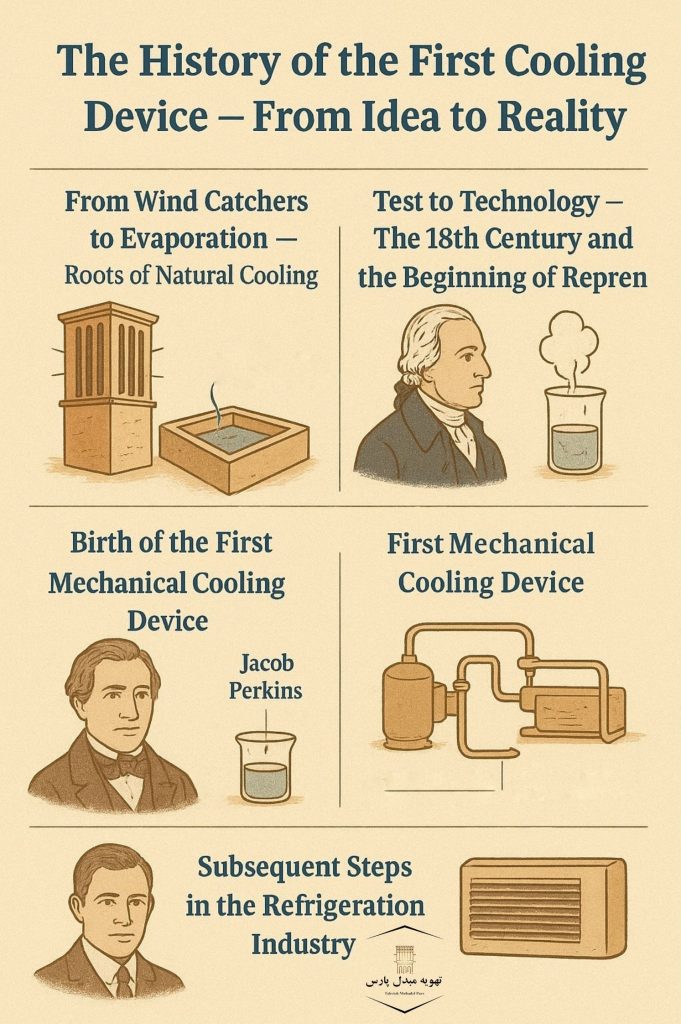
From Wind Catchers to Evaporation:
In ancient times, Persians ingeniously used wind catchers, underground water channels (qanats), and pools to cool living spaces.
Air passing through moist passages would become cooler before being directed indoors — a clever method that can be considered the foundation of natural ventilation.
In Egypt and Rome, water evaporation and circulation through walls were also used to moderate indoor temperatures.
Although simple, these methods were based on the scientific principles of evaporative cooling.
From Experiment to Technology — The 18th Century and the Birth of Refrigeration Science:
In the 18th century, scientists discovered that liquid evaporation absorbs heat from the surroundings.
In 1756, William Cullen, a professor at the University of Glasgow, succeeded in producing artificial ice by evaporating ether in a vacuum.
This groundbreaking experiment became the cornerstone for future refrigeration technology.
The Birth of the First Mechanical Cooling Device:
In 1834, Jacob Perkins, an American engineer, designed and patented the first vapor-compression refrigeration system.
His machine used ether as the refrigerant and consisted of a compressor, condenser, expansion valve, and evaporator.
This was the first closed-cycle refrigeration system in history — the same fundamental cycle that powers modern chillers and refrigerators today.
Next Steps in the Refrigeration Industry:
Following Perkins’ work, in 1856 James Harrison in Australia developed an industrial refrigeration system, which was used to cool beer and meat in factories.
But the true turning point came in 1902, when Willis Carrier designed the first modern air-conditioning system to control temperature and humidity in a printing plant.
This invention marked the beginning of a new era in the HVAC industry, inspiring generations of engineers and designers to create ever more efficient cooling systems.